The Suez Canal and the route to India and Australia
Opened in 1869, the canal cut London to Bombay from about 10,700 to about 6,200 nautical miles.
What it is
The Suez Canal runs about 120 miles across Egypt, from Port Said on the Mediterranean to Suez on the Red Sea. It is a sea-level canal with no locks. It was built by Ferdinand de Lesseps's French-led company and opened on November 17, 1869.
Why it matters
Before it, a ship from Britain to India or Australia had to sail down the whole west coast of Africa, around the Cape of Good Hope and back up the east side. The canal cut straight from the Mediterranean into the Red Sea, then out past Arabia into the Indian Ocean.
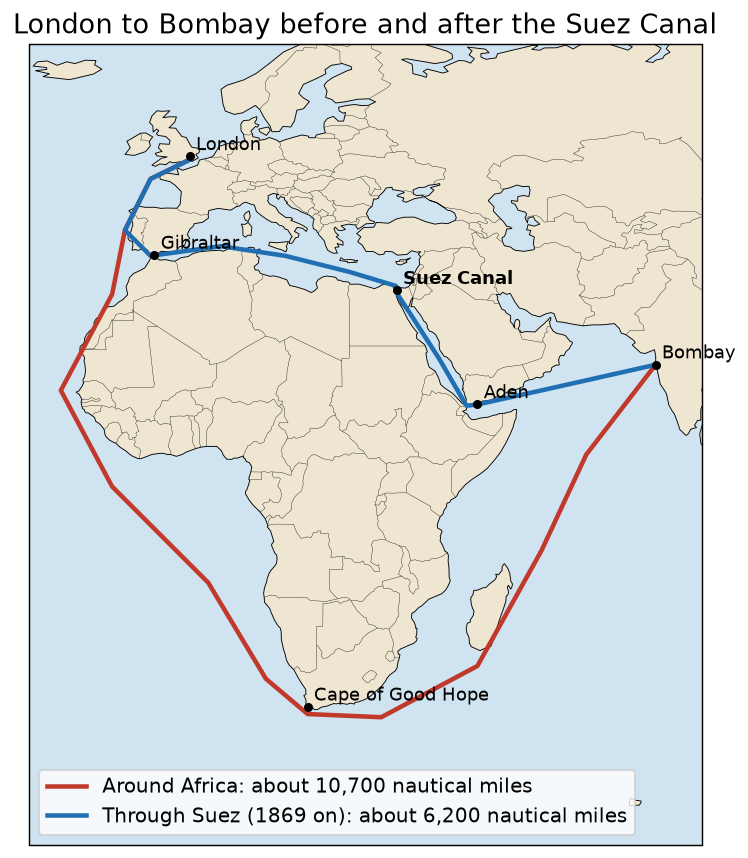
- London to Bombay: about 10,700 nautical miles around the Cape, about 6,200 through Suez, roughly 40% shorter.
- To Australia: the saving is smaller, because Australia lies farther south and east, but ships still saved weeks, and coaling stations along the Suez route (Port Said, Aden) let ordinary steamers make the trip.
That was the end of the Great Eastern's reason to exist: she had been built to carry coal for the long way around, and she was too big to fit through the canal. See the Great Eastern.
In the novels
Jules Verne has the Nautilus pass from the Red Sea to the Mediterranean through a secret undersea tunnel, the "Arabian Tunnel," beneath the isthmus, before the canal was even finished. Phileas Fogg passes through Suez in Around the World in Eighty Days (1872).
Key facts
- Suez Canal opened November 17, 1869 (Ferdinand de Lesseps); about 120 miles, no locks
- London to Bombay: about 10,700 nautical miles around Africa, about 6,200 through Suez
- Suez made the Great Eastern's design obsolete