Eratosthenes measures the Earth
About 240 BC, one angle (7.2°) and one distance gave the size of the whole planet.
Pronunciation
Eratosthenes: air-uh-TOSS-thuh-neez. Stress on the third syllable, TOSS.
Euclid: YOO-klid.
Bematist: BEE-muh-tist (from Greek bēma, a step).
Who he was
Eratosthenes of Cyrene (about 276–194 BC) was the chief librarian of the great Library of Alexandria in Egypt. He coined the word geography (geo, earth + graphia, writing or drawing), which is why he is called the father of geography. Rivals nicknamed him "Beta," second best at everything, because he worked in so many fields.
The clue
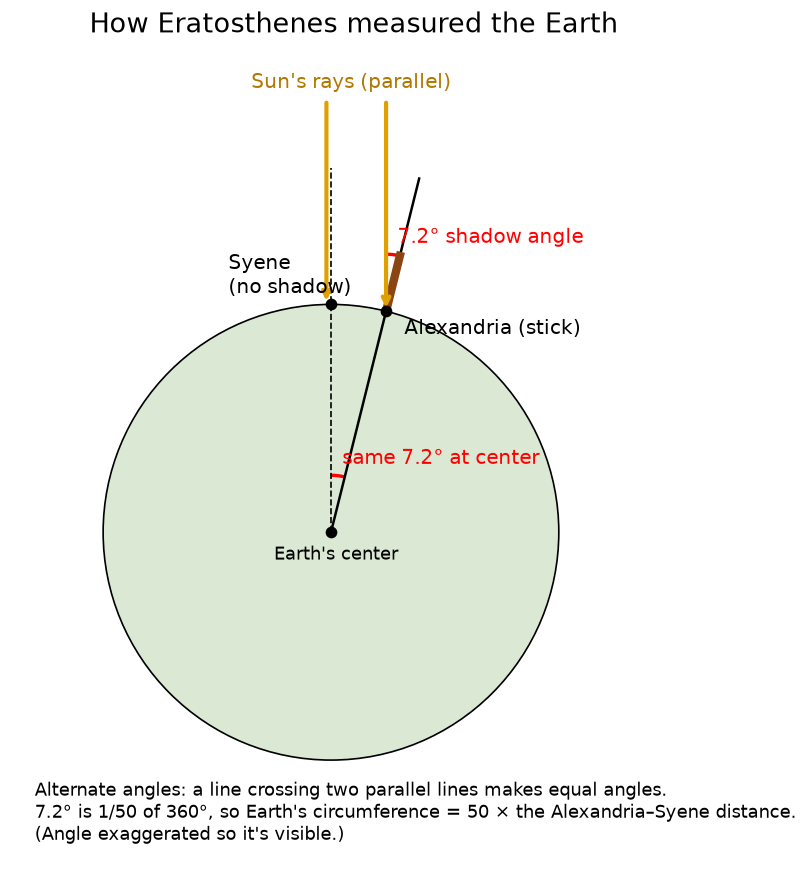
He heard that at Syene (modern Aswan), far up the Nile, at noon on the summer solstice the sun shone straight down a deep well, lighting the water at the bottom. An upright stick cast no shadow. The sun was directly overhead.
On the same day at noon in Alexandria, to the north, an upright stick did cast a shadow. The sun was about 7.2° off overhead.
The reasoning: Euclid's alternate angles
If the Earth were flat, the sun's parallel rays would make the same shadow everywhere. A different shadow means the ground is curved.
Treat the sun's rays as parallel lines (see why sun rays count as parallel). Extend the Syene stick and the Alexandria stick down into the Earth; both point to the center. The Alexandria stick's line is a transversal cutting across two parallel lines (the ray at Alexandria and the ray going down the Syene well). Euclid proved that when a line crosses two parallel lines, the alternate angles are equal. So the 7.2° angle at the top of the Alexandria stick equals the angle between the two cities at the center of the Earth.
The arithmetic
7.2° is 1/50 of a full circle (360 ÷ 7.2 = 50). So the distance from Syene to Alexandria is 1/50 of the way around the Earth.
That distance was about 5,000 stadia. 5,000 × 50 = 250,000 stadia (he later used 252,000). Depending on which length of stadion he used, that is roughly 24,000 to 29,000 miles. The true figure is about 24,901 miles. With a stick and a shadow, he was very close.
The bematists
How did he know the distance? Egypt employed bematists, professional pacers trained to walk with exactly even steps and count them, to survey land and roads. Their measurements, along with camel caravan travel times and royal surveys, gave the Syene–Alexandria distance. (Some of it was approximate: Syene is not exactly due south of Alexandria, and it isn't exactly on the Tropic of Cancer. The errors partly cancel.)
Key facts
- Eratosthenes (air-uh-TOSS-thuh-neez), father of geography: measured Earth with one 7.2° angle and one distance
- Euclid: a line crossing parallel lines makes equal alternate angles
- Bematists: Greek pacers who measured distance by counting steps (bēma = step)
- 7.2° is 1/50 of a circle; 5,000 stadia × 50 = 250,000 stadia
- True circumference about 24,901 miles; his figure was close