The shadow stick and why the lines meet at Earth's center
How the 7.2° was measured at Alexandria, and why a plumb line points to the center of the Earth.
Measuring the shadow at Alexandria
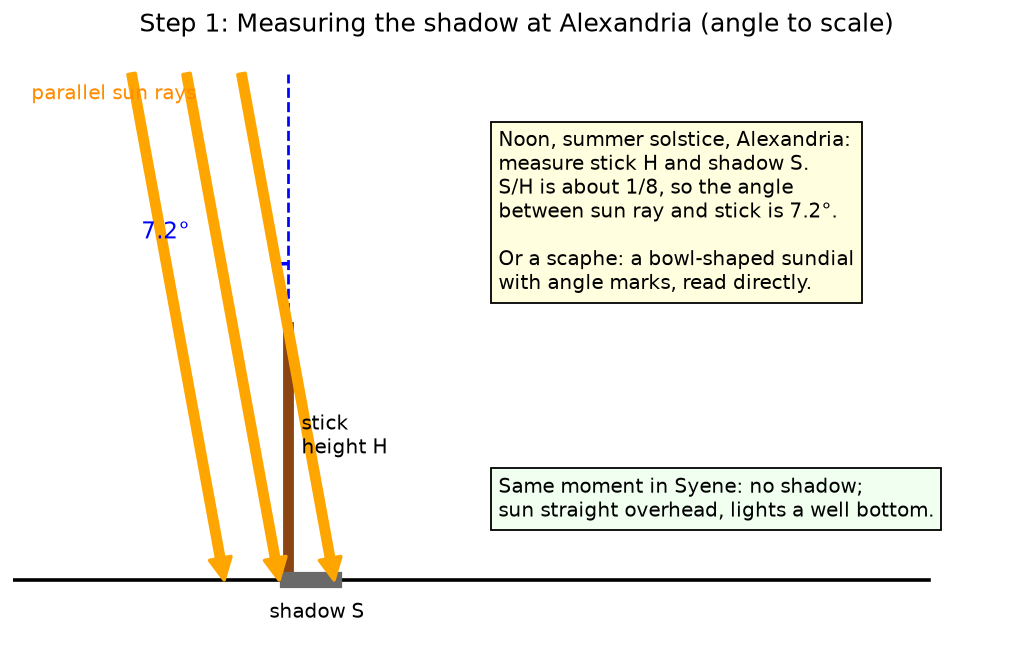
At noon on the summer solstice he stood a stick (a gnomon) perfectly upright and compared the length of its shadow with its height. The shadow came out at about 1/8 of the stick's height. A right triangle with those proportions has an angle at the top of about 7.2°.
He may also have used a scaphe, a bowl-shaped sundial with a pointer at the bottom and angle marks scratched on the inside, so the shadow's tip shows the angle directly.
How do we know the lines meet at the center?
Honestly, this was an assumption, but a sound one.
You make a stick "upright" with a plumb line: a weight hanging on a string. The string hangs the way gravity pulls. On a round Earth, gravity pulls toward the center, so every plumb line, everywhere, points at the center of the Earth. Extend the Syene stick and the Alexandria stick downward and they cross there.
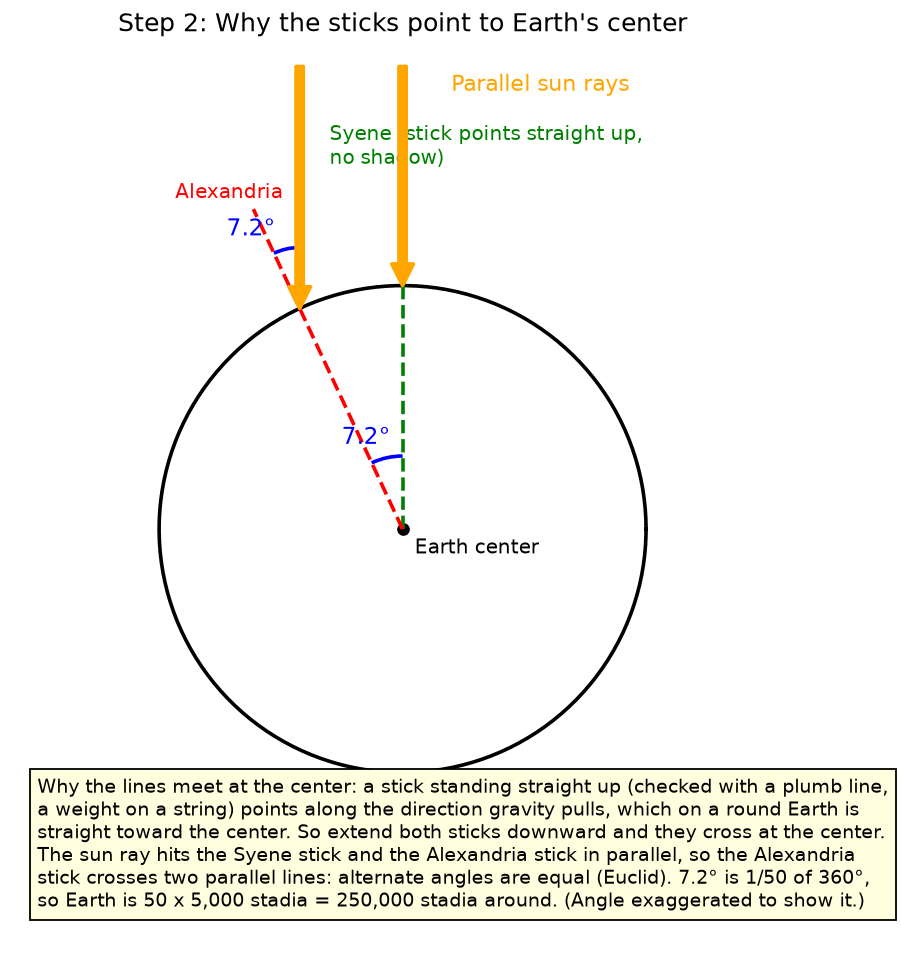
Then Euclid does the rest: the Alexandria stick crosses two parallel lines (its own sun ray and the Syene stick's line, which runs along the sun's ray), so the angle at the top equals the angle at the center. 7.2° is 1/50 of a circle, so the Earth is 50 times the Syene–Alexandria distance around.
Key facts
- At Alexandria the shadow was about 1/8 of the stick's height, about 7.2°
- A scaphe is a bowl sundial with angle marks
- A plumb line hangs toward Earth's center, so extended sticks meet there